
I used to think food preservation had to be big. Dozens of jars. Marathon canning days. Bushels upon bushels.
But there’s nothing like having the rug pulled out from under you (plus an epically horrible garden year) to give you a different perspective.
Little counts, too.
Even though my garden is beyond dead, I still have random vegetables hanging around from my Azure box and various grocery purchases.
My Mealcraft frameworks have been great for using up those odds and ends, but sometimes the assortment is a little too weird.
Or, to be brutally honest, sometimes I’m just over it and want them OUT of my fridge. (And I’m not quite ready to surrender it all to the chickens.)
Enter:
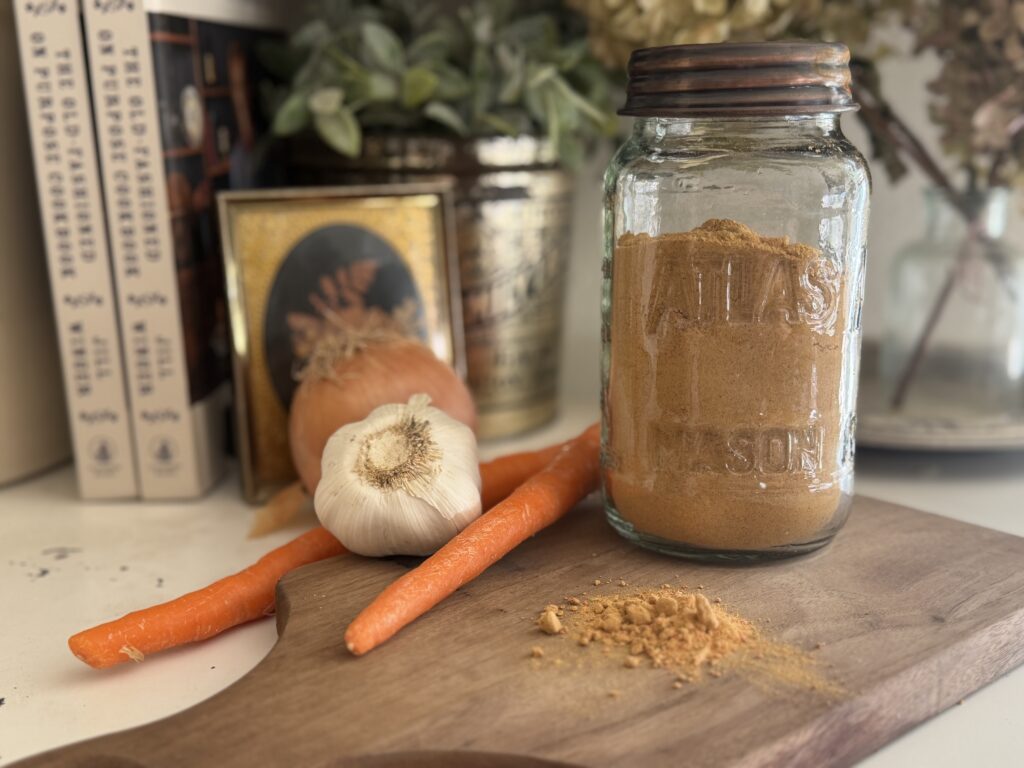
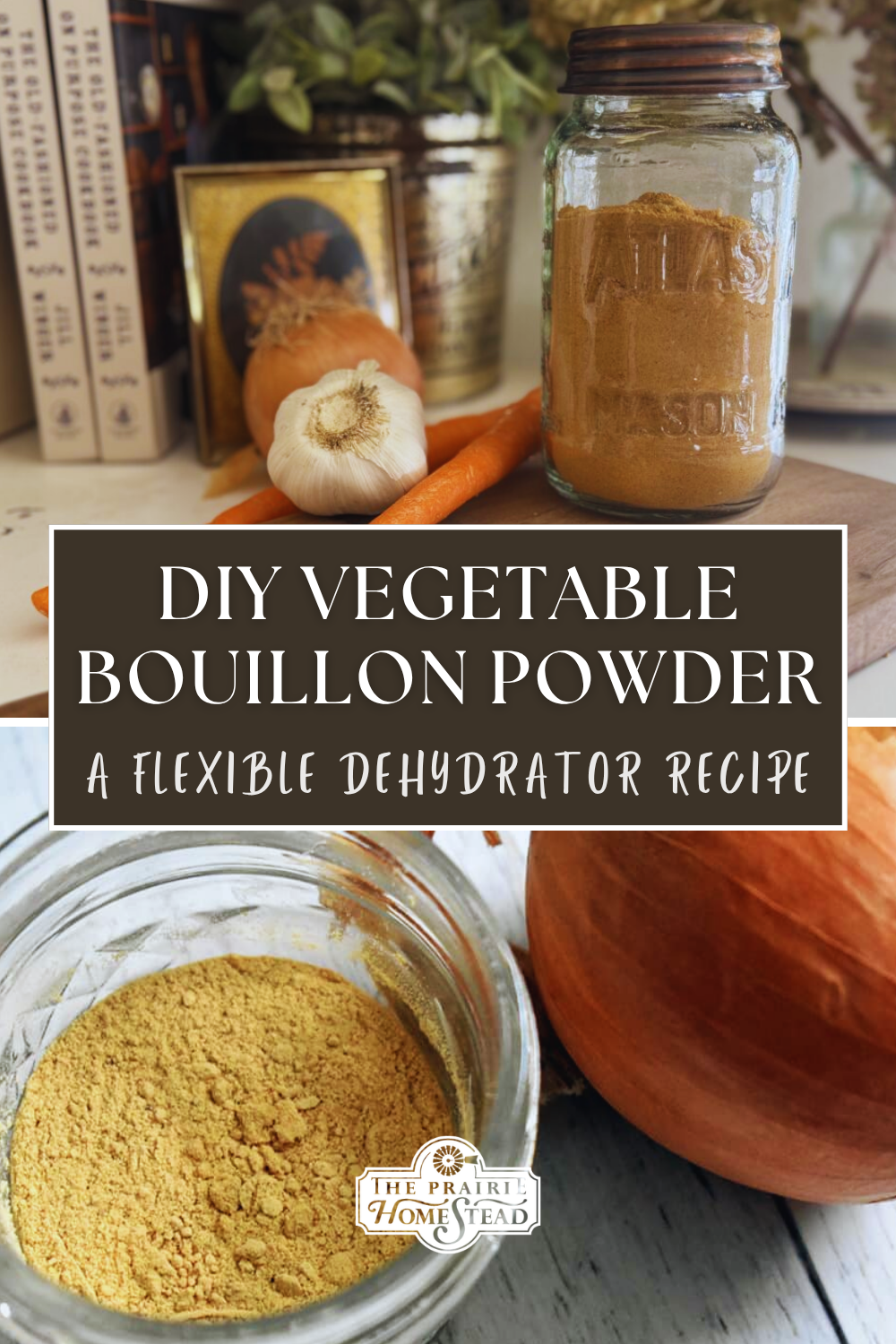
Homemade Vegetable Stock Powder
It’s basically homemade bouillon: a concentrated mixture of dehydrated vegetables, herbs, salt, and savory ingredients that you can stir into hot water or sprinkle straight into whatever you’re cooking.
It uses up a surprising amount of vegetable miscellany and takes almost zero brainpower.
YES PLEASE.
It also satisfies my squirrel-like propensity to tuck away food as soon as the calendar switches from summer into autumn.
Anyway, needless to say, it’s a win-win.
Is It Like Store-Bought Bouillon?
Kinda.
But this isn’t really about perfectly recreating those little foil-wrapped bouillon cubes. Plus, since our blend doesn’t have added MSG or a bunch of extra ingredients, it’s not going to be an identical match.
It’s more about turning food you already have into something useful.
Think of it as a savory vegetable concentrate you can use in:
- Soups
- Stews
- Beans
- Rice
- Grains
- Gravies
- Sauces
- Casseroles
- Skillet meals
- Anything that tastes like it needs a little something extra
Why the Nutritional Yeast?
You’ll see nutritional yeast in a lot of homemade vegetable bouillon recipes. It adds that extra punch of umami and helps the vegetable broth taste a little fuller, but you don’t have to use it.
I’ve had a jar sitting in my pantry for years from that time I was experimenting with homemade cashew cheese (ah, the good ol’ days….), so I used it in this round of bouillon powder.
If you don’t have any nutritional yeast or don’t want to buy it, just skip it and lean harder on other savory ingredients like:
- Mushrooms
- Tomatoes
- Tomato powder
- Onion
- Celery
- Garlic (raw garlic will add a bit of a bite to the finished powder– but I like it.)
The Vegetable Stock Powder Framework
This is not a rigid recipe on purpose, because it doesn’t have to be—especially when its whole purpose is to use up what we have.
Aka: You’ve got a lot of wiggle room here, my friend.
(Btw, if you like this sort of flexible cooking, you’ll love my Meal Craft Method.)
Here’s the walkthrough with all the deets, and the printable version is below.
THE BASIC HOMEMADE BOUILLON FORMULA
4 parts dried vegetables
1 part savory/umami ingredients
½ part herbs + aromatics
Salt to taste
That’s it.
STEP 1: Choose Your Veg
Use any combination of:
- Onion
- Leek
- Celery
- Celery leaves
- Carrots
- Bell peppers
- Zucchini
- Parsnips
- Garlic
I like a mix that’s heavy on onion and celery because they give it that classic stock flavor. And it’s ok if the veggies are past their prime. For my latest batch I used wilted celery and a thawed/squishy bell pepper that my stupid fridge froze.
Go Easy On:
- Broccoli
- Cauliflower
- Cabbage
- Kale
- Beets
- Strong leafy greens
They’ll work, but their flavors can be overpowering.
STEP 2: Add Something Savory
For every 4 parts dried vegetables, add about 1 part savory ingredient.
Choose one or mix several:
- Dried mushrooms
- Dried tomatoes
- Tomato powder (Here’s my full blog post with all the deets on tomato powder.)
- Nutritional yeast
- Extra dried onion
- Garlic
Mushrooms and tomatoes are especially good here because they add the deeper flavor we associate with broth. I used mushroom powder and tomato powder I had made previously.
STEP 3: Add Herbs
Add roughly ½ part herbs and aromatics.
Fresh or home-dehydrated herbs can be measured as part of that ½-part ratio. If you’re using dried, already-ground herbs from your spice cabinet, use less because they’re much more concentrated by volume. (Aka, please don’t dump in a 1/2 cup of ground rosemary.)
I rarely have enough fresh thyme or oregano around to dehydrate separately, so I usually just add a smaller amount of the dried herbs I already have.
Good options:
- Parsley
- Thyme
- Oregano
- Celery leaf
- Garlic
- Rosemary (use sparingly—it can be overpowering)
- Sage (same as the rosemary)
How to Make Vegetable Stock Powder
1. PREP
Wash your vegetables and slice them kinda thin and sorta evenly. This is an excellent destination for ugly carrots, celery leaves, vegetable ends, tired peppers, and other odds and ends. Don’t worry about making them beautiful.
I ran my carrots through the shredding blade of my food processor because I was in a hurry that day and rough chopped the other veggies.
2. DEHYDRATE
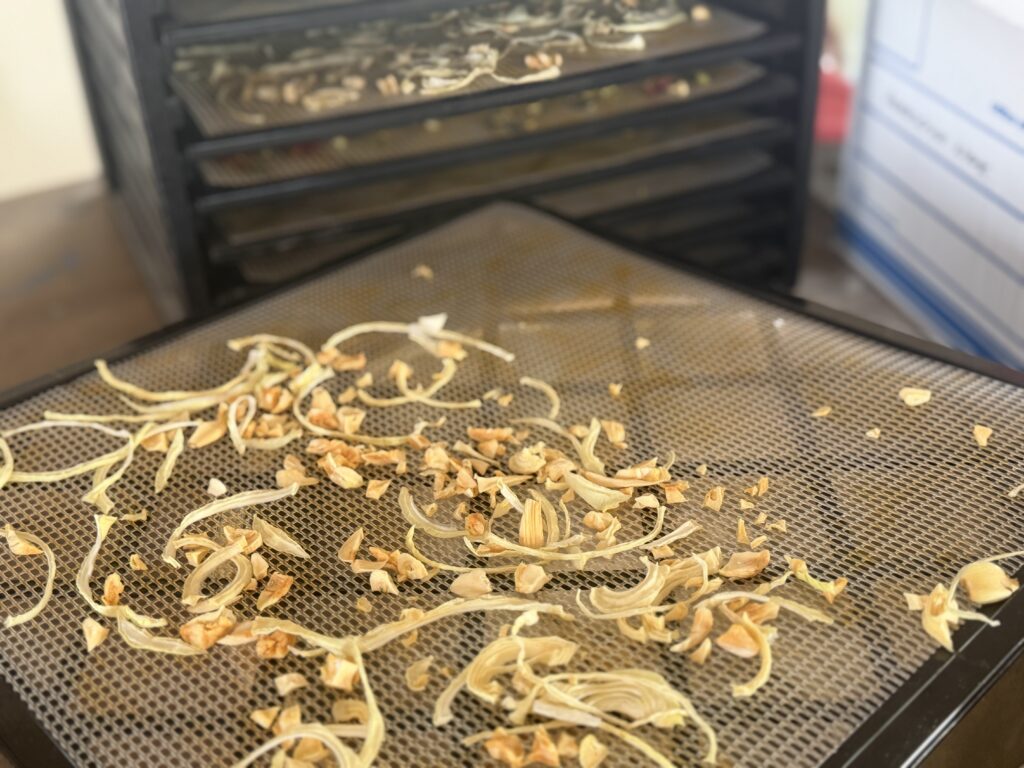
Spread the vegetables in a single layer on dehydrator trays. Dehydrate at approximately 125°F to 135°F until they are completely dry. And I mean completely. Shoot for brittle and crisp—not leathery.
Your drying time will vary depending on the vegetable, thickness, humidity, and dehydrator.
3. COOL
Allow the vegetables to cool completely before proceeding. This prevents condensation from clumping up your finished powder.
4. MEASURE
Once everything is fully dried, measure your ingredients according to the framework:
4 parts vegetables (I used a mix of carrots, bell pepper, onions, and garlic this time around.)
1 part savory ingredients (This time I used 1/2 cup nutritional yeast, 1/2 cup mushroom powder, and 1/4 cup tomato powder.)
½ part herbs/aromatics (This time I used a 1/4 cup TOTAL of already dried/ground rosemary, thyme, oregano, black pepper.)
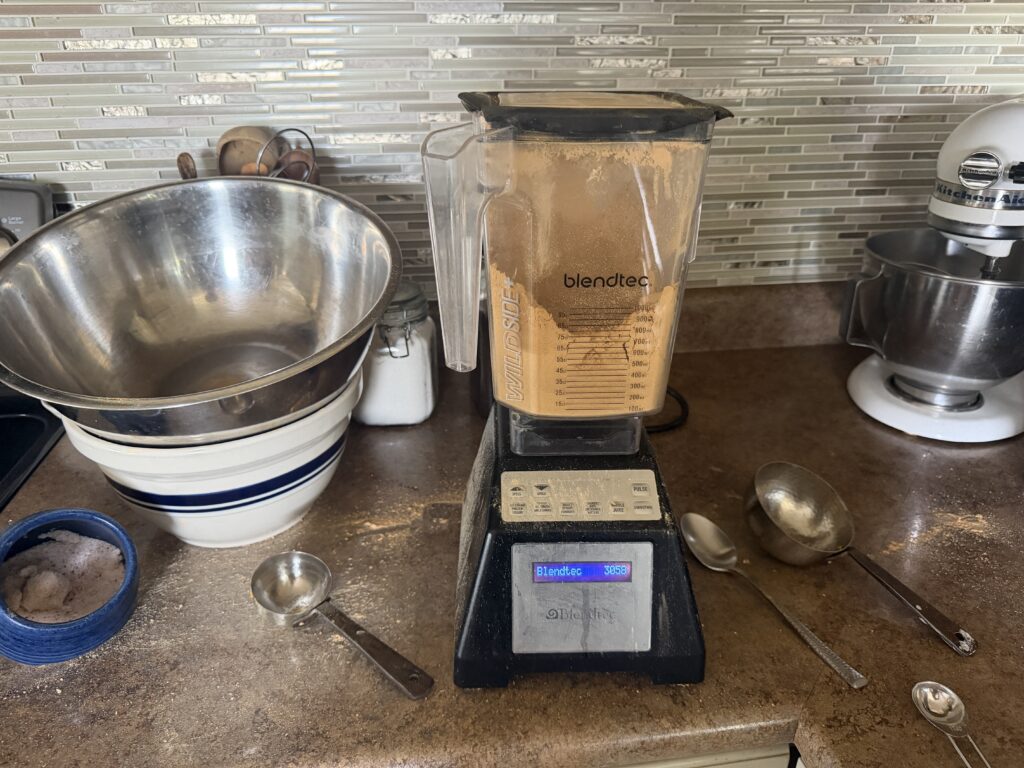
5. GRIND
Place everything in a:
- High-powered blender (the best option, IMO.)
- Food processor (this won’t produce as fine a grind as a good blender so be careful)
- Coffee grinder
- Spice grinder
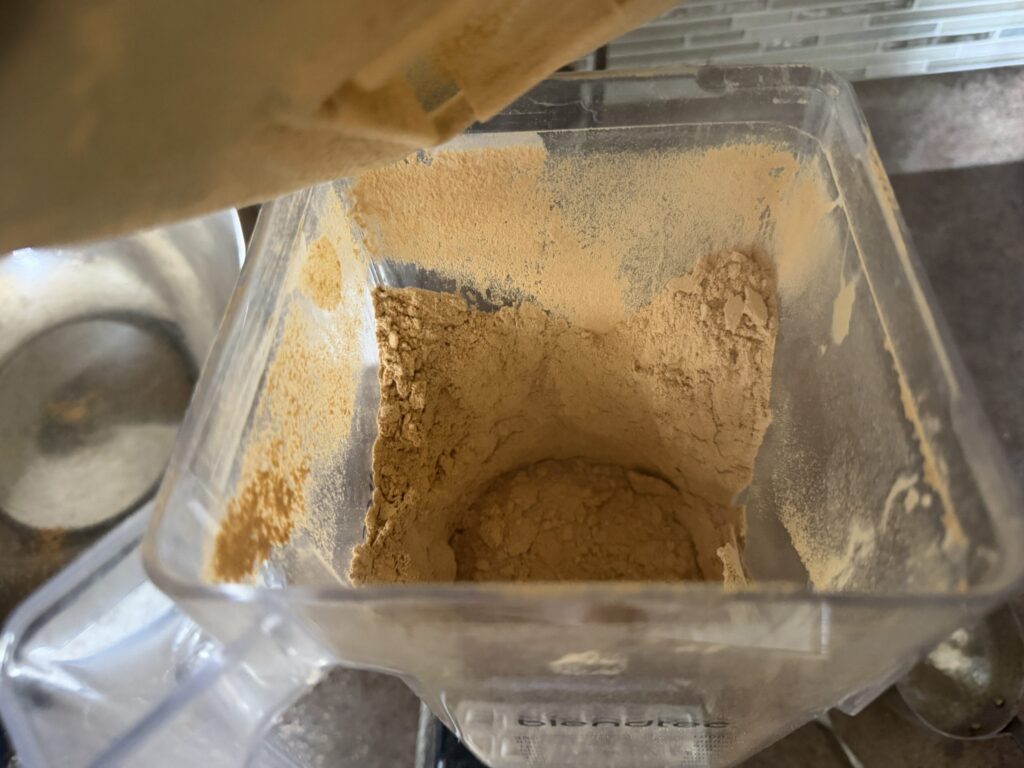
Grind until you have a fine powder. If necessary, sift out larger pieces and grind them again.
6. TASTE
Mix about a teaspoon of the powder into a 1/4 cup hot water and taste.
Then add salt, herbs, or savory ingredients until it tastes like something you’d happily use as broth. I added 2-3 teaspoons of fine sea salt to this batch. Don’t skip the salt- it makes a HUGE difference.
How to Use Vegetable Bouillon Powder
Start with approximately:
2 tablespoons vegetable stock powder per 1 cup hot water, then taste and adjust.
Or don’t even make actual broth and sprinkle the bouillon directly into whatever you’re cooking. (This is how I use mine the most.) A spoonful in a pot of beans. A little in rice as it cooks. A shake into gravy. A sprinkle in a soup that tastes flat. You get the idea.
Homemade Vegetable Bouillon Powder
Ingredients
- 4 parts fully dehydrated mixed vegetables
- 1 part dried savory ingredients, such as mushrooms, tomatoes, tomato powder, or nutritional yeast
- ½ part dried herbs and aromatics
- Salt, to taste (plan on 2-3 teaspoons per batch, roughly)
Instructions
Instructions
- Slice vegetables thinly and arrange them in a single layer on dehydrator trays.
- Dehydrate at 125°F–135°F until the vegetables are completely dry and brittle.
- Allow vegetables to cool completely.
- Measure 4 parts dried vegetables, 1 part savory ingredients, and ½ part herbs/aromatics.
- Grind in a blender, food processor, coffee grinder, or spice grinder until finely powdered.
- Test the finished powder by stirring a small amount into hot water. Adjust seasonings and add salt if needed.
- Transfer to an airtight container and store in a cool, dark, dry place.
- To Use: Mix roughly 2 tablespoons with 1 cup hot water for quick vegetable broth, or add directly to soups, stews, beans, rice, sauces, gravies, and other savory dishes.
An Note About Storage
This entire method depends on the vegetables being fully dehydrated before you grind them.
If there is still moisture in the vegetables, that moisture is now trapped inside a jar of finely ground food—which is exactly what we don’t want.
So, when in doubt, dry them longer. I’d also rather make several small batches throughout the year than one enormous batch destined to sit in the pantry forever.
Which, I suppose, brings me back to my larger lesson here:
Preservation doesn’t always need to be an enormous production.
Six carrots matter. Half an onion matters. One beet matters.
Saving a handful of vegetables from the trash and turning them into something you’ll use all winter is enough.
Little counts, too.
Love this Post? Check out these:
- How to Make Dehydrated Vegetable Powders
- Check out Meal Craft for more Flexible Frameworks
- How to Put Your Dehydrator to Work Around the Homestead
- How to Make Herbal Vinegar
Learn to Cook Like a Farmer!
Transform your kitchen into a farm style kitchen no matter where you live with my Heritage Cooking Handbook! It’s included as a part of my FREE digital homestead library.
Enter your best email for instant access! >>


Leave a Comment