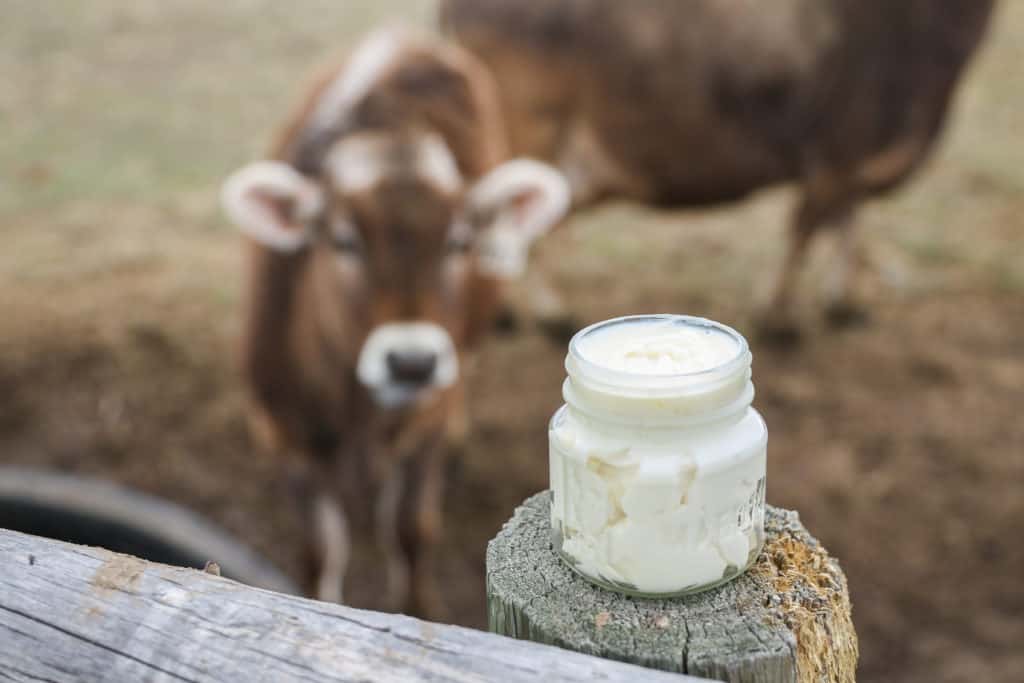
Our milk cow is probably the hardest working member of our homestead.
(Except for maybe this summer when we remodeled and painted the barn and shop. And built that 1/2 mile of fence. All within a 2 month time span…. then I think WE deserved that title…)
Our dear, sweet Oakley not only provides us with all the milk we can drink (and then some…), but she also is nursing not one, but TWO calves.
If you follow The Prairie Homestead on Facebook, then you know that our friend’s milk cow died unexpectedly after calving, so we ‘adopted’ their little heifer calf.
When we agreed to take the calf, I had NO idea how Oakley would respond. After all, she is a first-time mama herself. I had visions of struggles, bottle feeding, and the possibility of a lot more work for us.
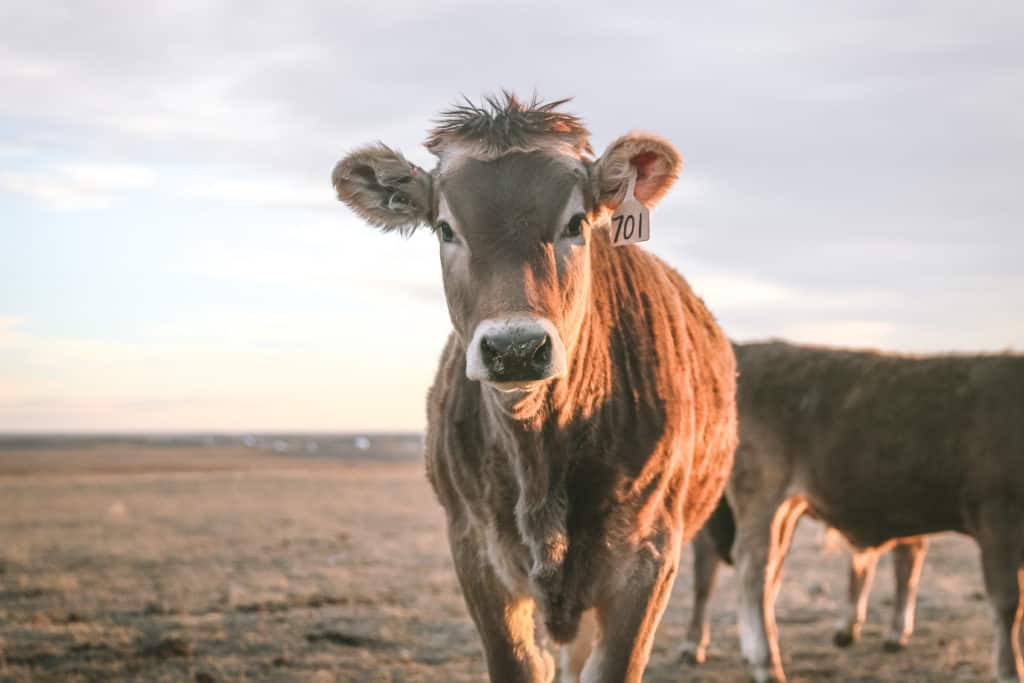
But, when we brought the little calf home and turned her in with our cows, Oakley turned and looked at her with her big soft eyes, blinked, and then went back to eating as the little heifer nursed.
What a relief!
So, for all the things that Oakley provides us with, I want to make sure she gets a little something special in return.
I know you can easily go to the feed store and buy pre-made, petroleum-based, udder balms. But why not make it at home instead? Homemade udder salve is not only simple to make, but it is also ultra-nourishing, and so natural you could eat it. (Ok, I’m not saying you should eat it. I mean, you could if you wanted to and it wouldn’t poison you, but please don’t actually eat it, m’kay?)
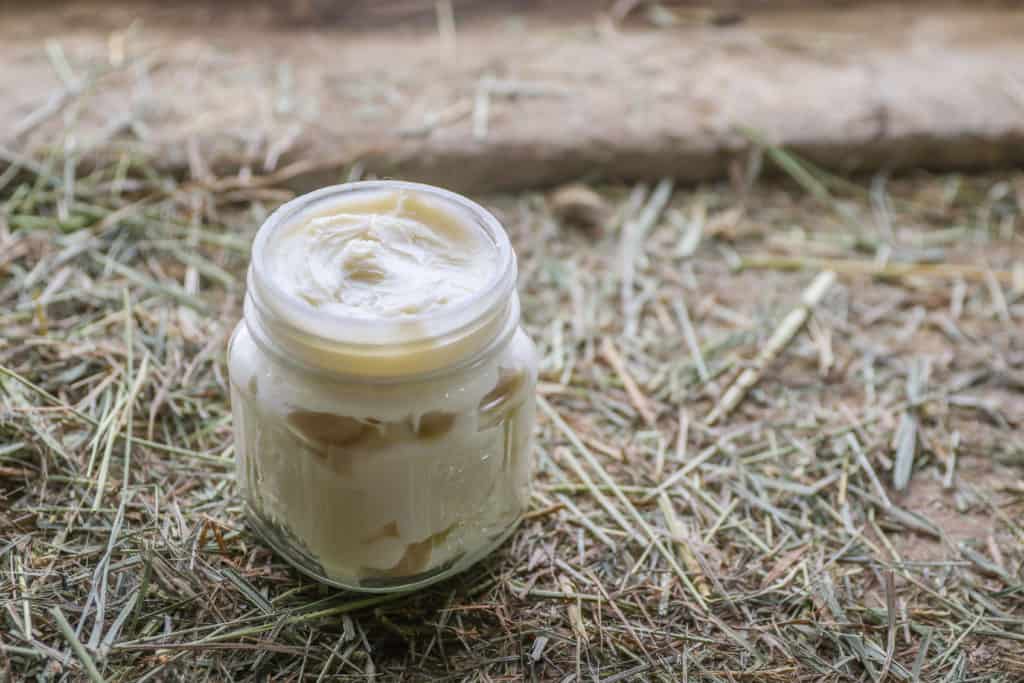
Homemade Udder Balm (For Cows and Goats)
(this post contains affiliate links)
- 1/2 ounce beeswax (where to buy)
- 1 ounce shea butter (where to buy)
- 1 ounce coconut oil (Expeller-pressed is fine (the kind that doesn’t smell like coconuts)) (where to buy)
- 3 ounces calendula infused oil (where to buy) or make it yourself (directions below)
- 2 drops lavender essential oil (how to buy essential oils for wholesale)
- 2 drops melaleuca essential oil (how to buy essential oils for wholesale)
To Make Your Own Calendula Infused Oil:
Place dry calendula leaves in a very clean, dry glass jar. Cover them completly with olive oil. Cap tightly and place in a warm, sunny window and allow to steep for 2-4 weeks (the longer the better). Give it a good shake once a day or so (or whenever you happen to think about it). When you are ready to use it, strain out the leaves.
Calendula is thought to have anti-bacterial, anti-inflammatory, and anti-viral properties. It’s a favorite herbal treatment for healing minor cuts, scrapes, and burns.
To make the udder balm:
In a double boiler, melt the beeswax. I use a hill-billy double boiler setup:
I fill a small saucepan 1/2 way full with water and place a Pyrex measuring cup (or some other stove-top safe container) inside. I place the beeswax in the Pyrex, and allow it to melt over medium-high heat. (Using beeswax pastilles, instead of bars, makes the melting process easier…)
Once the beeswax is melted, add in the shea butter and coconut oil. Gently stir, incorporating everything as it melts. Add the calendula oil, mix together, and then remove from the heat. Add the essential oils.
Store in a small glass or plastic container (if using plastic, allow your mixture to cool a little before pouring it into the container). Make sure you choose something large enough that you can reach your fingers inside to scoop out the salve.
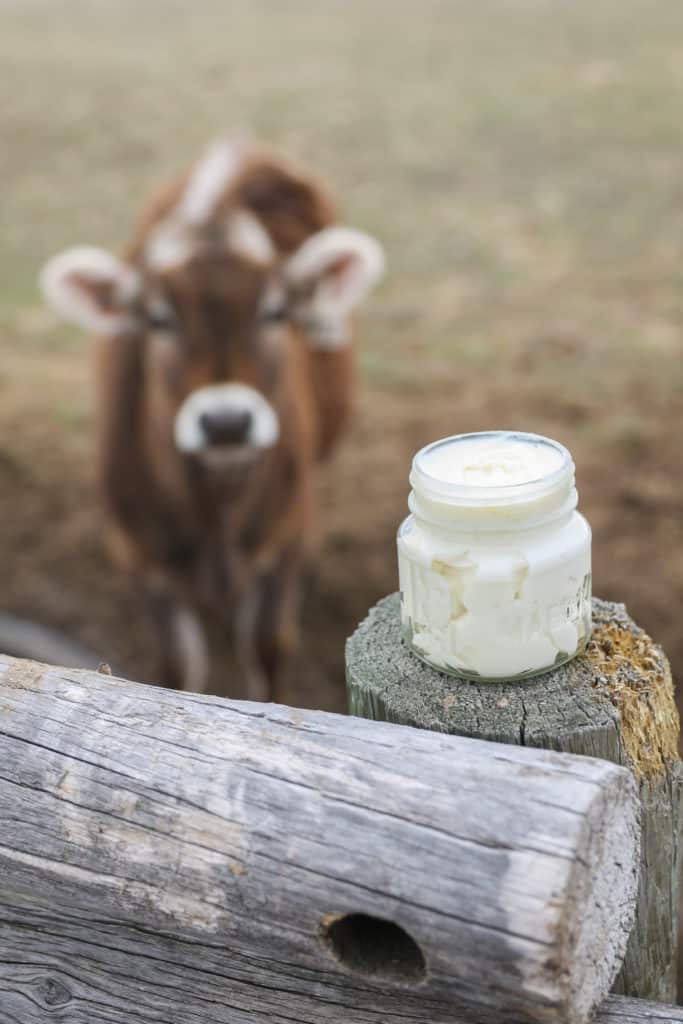
Apply frequently. I like to use it every morning after milking.
A few notes:
- I’ve seen several udder balm recipes calling for peppermint oil. I thought about including in my recipe, but then I also got to thinking that peppermint seems to make everything feel colder. I’m not sure that would feel the greatest on a wet udder when it’s already 20 degrees (or less!) outside.
- I do NOT recommend leaving this out in the barn when it’s cold… It will turn into a solid brick. I leave mine in our mud room and just slip it into my pocket when I head out the door to milk.
- Don’t stress out over the measurements. Feel free to play around with the indgredient amounts- it’s pretty flexible. If you want it harder or softer, try adjusting the amount of beeswax you use. The more you add, the harder it will become.
- This is wonderful for your own hardworking hands and feet, too!
- It’s good for a ton of other animal ailments too, not just udders. Or use it as a basic salve base, and add other essential oils for different healing properties.
Interested in more frugal homestead ideas? Check out these other posts:


This made me giggle. Not that chapped udders are particularly funny but I just published a post about my favorite homemade hand salve and the recipes are nearly identical! What’s good for the teats is great for the hands…I use it after I wash dishes :)Found you on the Green Resource….come “visit” me sometime!
Too funny Stephanie! I do love using this on my hands too! It’s a great recipe. 🙂
Jill,
I have really back dry hands nuckles on hands and cracked and sometimes bleed, would your salve help my hands and heal them? The only thing I’ve come across so far that helps is awuaphor advanced therapy it usually takes a couple of days depending how bad my hands are but it helps! This is due to washing my hands a million times a day it feels bc I have a 4 week old daughter, plus 2 older kids 8 & 4, that go to schools so I’m extra cautious with baby Olivia!
Bad not back
I think it’s worth a try!
This sounds like it’d be lovely for people, too! Cracked heels, anyone?
Oooh yes, definitely cracked heels. Mine are horrible right now!!
Why do you use and infusion instead of an essential oil of calendula. (I’m ignorant, maybe there isn’t one?)
Good point Cecilia- I just looked it up and apparently their IS Calendula essential oil- so I’m thinking you could definitely use a bit of that along with your olive oil as well. I just happpened to have the dry leaves as well as olive oil, so just decided to go with the infusion.
You are a genius!!! This is almost identical to what I make for hubby. I melt mine in a small crockpot I picked up for a dollar, one of those for keeping dip warm. It works great in case I get sidetracked and forget(which happens most of the time) I am melting, never scorching.
Awesome use for the little croc pot dip warmer. Im so go to do this. Didnt know it could get warm enough.
I love the story of how she took in the other calf. Sweet.
Fascinating Erin! I think you are definitely on to something. This definitely warrants some more research!
I don’t have cows, but this does look like it would be a wonderful hand salve. My hands get dry in the winter, and I’m always trying to find a recipe for a salve that’s gentle, all natural, etc..
What a great idea! We buy udder cream for my daughter’s hands, and this should work so much better for her!
Annie Kate
I’m laughing at myself – I’m at the ‘about to pop’ stage of pregnancy, as my husband put it earlier today, and of course thinking about upcoming breastfeeding. When i saw your ‘udder’ title on WFMW over at We Are That Family I automatically thought that was an alternative to putting breasts/nipples. So when I clicked over and saw you were actually talking about cow’s udders, I couldn’t help but laugh!
Deb, that made me laugh! I actually had wondered if I should change the title on that, b/c I was wondering if people might take that the wrong way. 🙂 Congrats on your upcoming addition, btw!
I think it was just a good hook to draw folk in!
And thanks, it’s number two, so we sort of know what’s about to hit us, but of course, it’s still a big change and will be a shock to my toddler who’s used to getting all the attention!
Thank you for your submission on Nourishing Treasures’ Make Your Own! Monday link-up.
Check back later tonight when the new link-up is running to see if you were one of the top 3 featured posts! 🙂
Love this and can’t wait to try it! I’ve got one of those tiny crock pots that came with a bigger one that I’ve never used- I think I will dedicate it to making this stuff. I do have a question, though- I’ve got some pure lanolin on hand and I am wondering if that would benefit this udder balm by mixing some in as well? I used to love Bag Balm, but don’t like the chemicals in it and as a result have stopped using it. However, I believe the lanolin in it is what I really like, because it helps it last longer and not absorb/dry out as quickly on your skin. Wondering on your thoughts regarding this?
I’ve never put lanolin in mine, but I have seen a couple different recipes calling for it. I definitely think it would work! Especially that is often used for human “udder” creams. 😉
I had some home made comfrey salve, I took a little bit of it and added a bit of calendula oil and lavender es. oil. Just made up a little bit and put it on my cow…. her little cracks from the washings and cold have just about disappeared in two days.
I love the stuff… I’ll be organized at some point and actually make up a batch just for the cow.
When everything else is failing we tend to look for the best one which can pacify and meet our needs specially when it pertains to our skin or health. It’s a good thing that there is a cow’s milk which is in no doubt can greatly help us maintain a well state of optimum and balance health. It saves time and effort as well for you don’t need to go further and look for it.
I find it great that more people are becoming self efficent. After reading and researching some of the chemicals that are being put in our food supply my family and I decided to start our own homestead 3 years ago we are new at it and learning as we go. However it is very rewarding and even though we still have a ways to go I am loving all the natural homemade items and providing safe food for our family. I hope more join in and remember why the good old days are just that.
About the use of tea tree oil…from what I understand about it, a nursing woman is not to use it, as it gets into the milk…thus the infant ingests it which is not supposed to be good. Wouldn’t this do the same for a cow? That would be my only concern with the essential oil part.
Hi
Just wondering do you apply this after milking? Got a doe due to kid in 3 weeks so thought I could rustle some up now and pamper her!
Thanks
Yes, I usually apply after milking. However, you could totally apply it whenever you think she needs it, or if her udder is especially dry.
Would cocoa butter work instead of shea butter? I have cocoa butter on hand.
Yes, that should work just fine as a substitute. 🙂
Yep- should work just fine!
Hi!
Thanks for sharing this recipe… I’m definitely keeping this one. I can’t use shea butter because of allergies… could I use more coconut oil instead?
Thanks!
Yes, you could probably just use more coconut oil– or try cocoa butter perhaps?
Hi Jil…Do you dry your own calendula leaves ? I grow marigolds every summer. I should probably dry a bunch.
I don’t… yet! Hope to in the future. 🙂
Well, after doing more research, I found that I am to use the petals for the infussion and NOT the leaves and to grow Calendula Officinalis NOT Common or Mexican Marigolds. Hope this helps everyone.
Are all the ounces here by weight?
Yes. 🙂
If it will only be used by humans, would it be ok to use unrefined virgin coconut oil (smells like coconuts)?
Yep- that’ll work just fine!
I made the same thing only I infused lavender and calendula. I use it morning and night on my cow after milking. I swear by this! She star
Hi Jill
I just made this balm and THEN decided to read all the comments. One question I have not seen come up though is :
Is it ok to use this on a milking goat who is already currently nursing her twins? I milk her twice a day and her babies get all they need/want day and night. Is it ok for this to be on her tears and for them to “suck it off”?
Thanks!
Mk
I don’t think that should be a problem. I most always end up applying it before I turn my cow/goat back in with their babies. Sometimes it’s hard to avoid it! 😉
Thanks for the recipe. I have calendula in the garden and dried petals too. Will be making soon. To clean the udders and teats, I make my own by using warm water, a little organic dish soap (about 1/8 tsp.), 3 drops of tea tree oil, and 1 drop lavender essential oil (theraputic/medicinal grade). Smells yummy. I cut up linen cloths into squares and use those. I wash/dry and re-use them. Looking forward to using your udder salve:)
I like that udder wash idea!
Thanks! I thought about using ‘Wipe Out’, but hate having to throw stuff in the garbage after one use and the website that I was looking at did not list the ingredients. Another thing I do for the goat barn is mix lavender EO with DE in a container with a lid. Stir and let sit (smells really good). Sprinkle on bedding (we use rice straw). Both DE and lavender helps to keep the bugs away. I do the same for the chicken coop.
Every winter I end up with an eczema type rash on the top of one of my hands. I have been using a similar recipe (lotion bar) sans the shea oil (because I don’t like the smell much), calendula oil and only using lavender EO. my hands have been soft and supple! Never going back to store bought creams/lotions. I can only imagine how wonderful this would be for the cows and for the milker’s hands as well! 🙂
Wow– that is awesome Jessie! And good to know for future reference, too. 🙂
Jessie, would you be willing to share your lotion bar recipe? My hands aren’t handling the recent cold weather very well.
Thanks so much!
Clo
Yes! 🙂
Looks great! Thanks for sharing!
If you have newsletters that u email out I would love if you signed me up. Have so thoroughly enjoyed everything you post on Facebook. Thank you.
Glad you are enjoying my FB page sheri! You can sign up for email updates here: https://www.theprairiehomestead.com/subscribe-for-free-updates
I’m looking forward to trying this recipe. I recommend using a wide-mouth Mason jar in a pan of simmering water to melt the beeswax. After it cools, you can use the lid and ring to cover it. I use the same trick for melting a combination of beeswax and butter to grease candle molds.
Darned autocorrect. I meant canele (a small French pastry) molds.
Not calendula leaves, its the petals from the flowers ( in the part about infusing the oil)
Exactly -I was thinking this would be great for nursing Moms and their babies little bottoms too.
Back in the 60s a neighbor had a baby. My Dad bought her a jar of bag balm, thinking he was being helpfull, but she ws super embarrased and horrified when she found out what it was for. Ah Suburbia!
Great Recipe 🙂 I use beeswax, Calendula infused olive oil, propolis tincture and lavender oil in out ‘Divine Miss Daisy’s tit balm’ 🙂
It also makes a nice lip balm and hand salve for humans and at a pinch can make a nice polish for work boots too.
Not sure if cows are the same as humans, but I wanted to add that peppermint oil can dry up milk in nursing mamas.
I just made some lotion bars with sunflower oil infused with dandelion petals, bees wax, shea butter and coconut oil. My hands have never so soft. Dandelion is very healing, so I wonder if it will work for a milk goat? I am sure going to try it! Thank you for the idea!!
I’m 75 years of age, always had very dry skin, & age has made it even drier. It’s a big problem. Many years ago I heard about Bag Balm from a Rancher. Didn’t say anything about buying some for my own skin (figuring people would think I am nuts), & am so thankful for Bag Balm! Many years ago, my mother went to 3 different doctors about her feet, her heels would crack & bleed. (Mainly wore sandals, heels always open on shoes.) Once I convinced her to use Bag Balm, she was so happy & wanted to tell those doctors to let people in on this “secret” that actually works. In the small town I live in, nether one of our HEB’s or Walmart carries Bag Balm any longer. I thank you very much for the recipe, also in being so thoughtful as to how we can print it out.
Yes, I’ve known many a rancher to swear by bag balm! Glad this recipe can be a substitute for you Dee!
Is this recipe greasy at all? Do you use it before and after milking? Does the coconut oil melt it the udder balm is in the heat (re: hot house in summer)?
I have a doe that I believe has congested udder. Can I use this recipe before I milk her, to get her milk to flowing? Would it make the milk taste weird or anything? She as a super nice udder. Last night I got the milk to flowing then it just stopped.
I don’t think it’s overly greasy. I usually use it after milking. It will definitely get softer when the temps are warmer.
I would try to avoid getting it in the milk, but it’d probably work OK to massage the udder prior to milking.
I am planning to make this recipe, for udder balm, to use on my dairy goats. However, when I read your instructions for making calendula oil, I was confused. It said,
“Place dry calendula leaves (where to buy) in a very clean, dry glass jar.”
I have made my own calendula oil, using calendula blossoms, that I grew in my garden. According to Mountain Rose Herbs, the healing constituents in calendula blossoms include:
Triterpene glycosides and aglycones, carotenoids, essential oils, resin, sterols, flavanoids,
I have never heard of using calendula leaves in calendula oil. Although, that’s not to say, there wouldn’t be benefits in the leaves.
Is it possible you meant to say use calendula blossoms in the calendula oil?
I also plan to use Comfrey Oil, in my Udder Balm, as it had many topical healing qualities.
Thanks for all the work you do, to help us homesteaders, be mor successful.
Yes, you use the blossoms.
I’m sure you are very busy but not everybody reads the comments. Might I suggest you edit your recipe to Calendula BLOSSOMS?
Sure– I can fix that
How soon after calving do you start milking the cow if your only going to milk once a day? Can you just milk occasionally or should you have a definite schedule?
Hi Jill
LOVE this bag balm!! Now would you have a recipe for bag wash? I have a gorgeous purebred Jersey, 5% cream! Her bag is udderly (LOL) massive, and huge teats! Anyway, I milk by hand only, but am looking for something far more gentle than the toxic stuff available, Baby Max needs to eat too! And a Jersey’s skin is quite thin, sooo something gentle is a must! Thanks!
What can I substitute for the coconut oil? I am allergic to coconut. Thank you!
Great recipe … I also love your Tallow Soap recipe. As I butcher my own cow, I have lots of leaf fat to utilize and keep from going to waste. That being said, could this balm be made with Tallow? Ever tried it?
I’m sure it would work the same!