
“Jill, you’re up first.”
The second I hear the words, my stomach flops. My hands quiver as I pull my rope from the saddle and fumble through the coils, trying desperately to look competent while feeling the exact opposite.
You see, the movies have it all wrong.
They make you think when you finally do the thing you’ve wanted your whole life, it will feel heroic. Cue the epic soundtrack. Slow-motion victories. The triumphant moment where everything clicks into place.
But in real life, it feels more like a red face, pounding heart, and waves of nausea.
Sometimes the victory is hidden right in the middle of the most cringey, exposed, embarrassing moments your brain can conjure up.
Honestly, I think we need to talk about that more.
Learning to rope at age 40 has been humbling in every possible way. And not just privately humbling. Publicly humbling. The kind where you think, I cannot believe I just did that in front of actual people.
Missed shots. Dropped ropes. Bad swings. Lost dallies. Hitting my horse in the head with the rope. Hitting myself in the head with the rope. I’ve done it all, and then some.
And it does NOT feel good. It’s mortifying and horrifying and yet… I keep going back for more.
Now more than ever, I understand why it’s so hard for adults to learn new skills later in life.
It’s acceptable for a child to be a beginner. We expect it. We even cheer it on.
Adulthood is different. By the time you’ve built an identity and gathered some life experience, you’re used to moving through the world feeling somewhat capable. You know your lanes. You know how to protect your image and avoid looking like an idiot.
But when something new calls to you—or life demands a new stage of growth— just like that, you’re a beginner again.
And let me tell you: awkwardness hits a lot harder when you’re 40 than when you’re 14.
The humiliation is thick, man.
So lately, I’ve been repeating one phrase to myself over and over:
Embarrassment is the cost of entry.

I think one of the biggest reasons people stay stuck is not because they lack discipline, talent, or information. I think it’s because they cannot tolerate the feeling of looking foolish.
Because embarrassment rarely feels like a simple, harmless, Oh well, I messed up.
It feels more like: Oh no. I didn’t just mess up— I got exposed!!
And it burns. It burns right through the polish and performance and exposes the part of us that says we like growth—but only if said growth happens in a dignified, aesthetically pleasing way.
But my darling, that’s rarely how growth works.
Growth is awkward. Clumsy. Stretching. It kicks your ego square in the teeth.
But that is the cost of becoming. And it is worth every penny.
Because what is the alternative?
Whenever I feel scared of being seen in my fumbling beginner hood, I weigh the options. My conversations with myself go something like this:
Option A: Protect your ego. Stay in your lane. Keep up the appearance of competence. Avoid embarrassment. Avoid gossip. Avoid looking silly. But go to your grave never exploring the thing that tugged on your soul.
Option B: Go all in. Chase the dream. Ignore the peanut gallery. Let yourself be seen trying. Maybe look foolish. But actually live my one wild and precious life (thank you Mary Oliver.)
When I frame it that way, things get clear, fast. So I lean in.
Even when my face is red. Even when I feel like I’m drowning in self-consciousness. Even when I miss yet another calf with six cowboys watching.
Being a beginner has a way of stripping you down to the truth. It forces you to face yourself. It shows you how attached you were to that shiny image you’ve so carefully curated.
But if you can stay in that discomfort long enough, you eventually earn the greatest reward of all:
Real confidence.
Not the curated, surface kind. I mean the battle-tested kind. The kind that comes from walking straight through the fire, sticking with the thing, and coming out the other side with a few scars and a head held high.
That kind of confidence is life-changing.
And that’s why I keep putting myself in these wildly awkward situations.
Not just because they might eventually make me better, but because they’ve taught me I can trust myself.
And once you realize you can survive embarrassment, it loses some of its power.
That’s a superpower you’ll use for the rest of your life.
In starting a business.
In shifting your worldview.
In learning to cook, to ride, to lift, to lead, to make art, to build a life that actually fits you.
Even in leaving behind an old identity and fumbling your way toward a truer one.
So many people aren’t stuck because they’re incapable. They’re stuck because they are unwilling to be seen starting at ground zero.
So these days, when I feel the familiar flush of self-consciousness rise up… when I miss yet another calf… when I feel the weight of not being good yet… I try to remember:
This is not proof I’m failing.
This is proof I was brave enough to enter the arena. This is proof I have not arranged my whole life around protecting the illusion of competence.
And that feels like a worthwhile trade.
I doubt I’ll ever be a great roper, though I hope I get better eventually.
But I do know this:
Every time I pick up my rope and try again, I become someone I respect a little more.
And that is reason enough to keep going.
-Jill
P.S. My embarrassment mantra comes from this quote by Ed Latimore: “Embarrassment is the cost of entry. If you aren’t willing to look like a foolish beginner, you’ll never become a graceful master.”
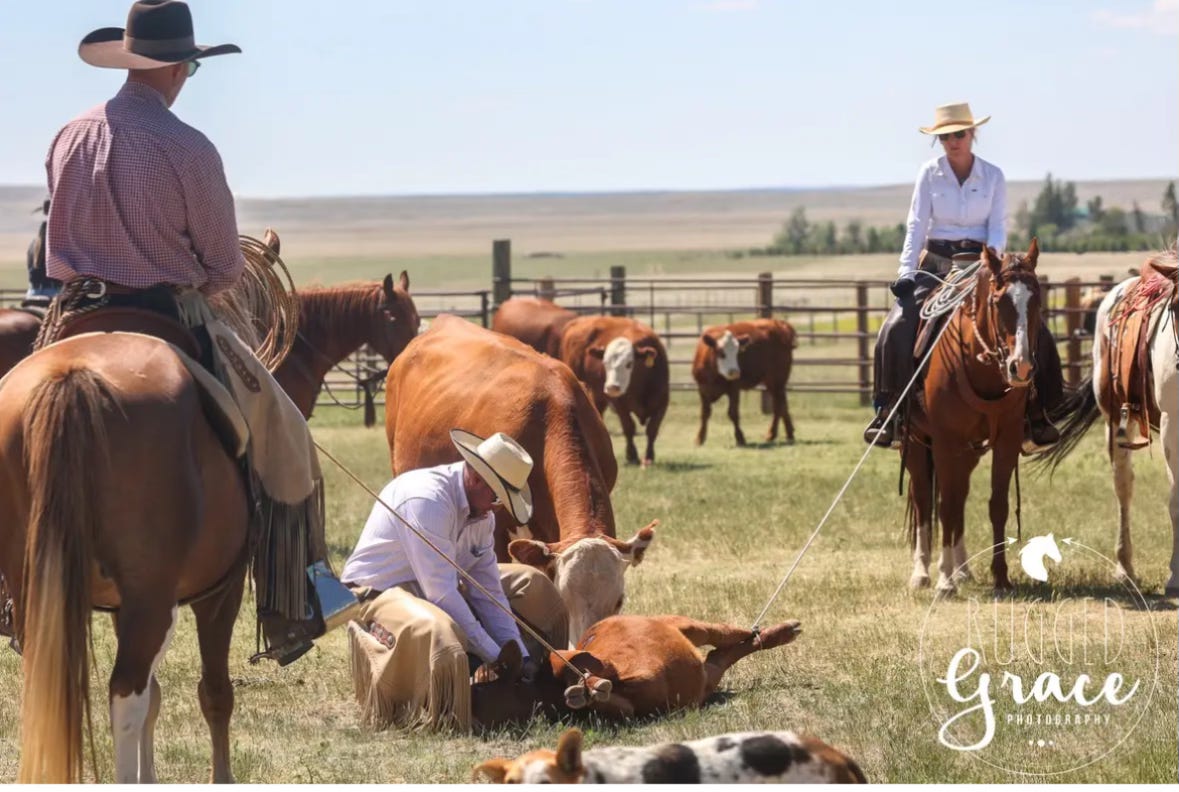
P.S.S. These photos make me look way cooler than I am. Kudos to our amazing photographer, Kelly from Rugged Grace Photography.




Leave a Comment