From Barn to Fridge: 6 Tips for Safely Handling Raw Milk

raw milk safety home dairy

Since it’s Home Dairy Month here at The Prairie Homestead, we’ve been talking about one of my favorite topics: raw milk.

As I shared last week, I have weighed the risks involved with drinking raw milk, and am very comfortable with my decision. I feel as though the risks of drinking unpasteurized milk are minimal compared to the possible health issues that can arise from consuming pasteurized milk.

That being said, if you plan to have home dairy animals and produce your own milk on your homestead, it’s still important to treat fresh milk with a bit of respect.

I follow a pretty strict set of procedures when I head out to the barn each morning to bring in a bucket of fresh milk. Here is what I do to ensure that our milk is as clean and sweet-tasting as possible.

Six Tips for Safely Handling Raw Milk

1. Clean it- Before sitting down on my stool to milk, I wipe off Miss Oakley’s udder with a hot, wet towel. She likes to lay in the mud, so sometimes it takes a bit of elbow grease to get her teats clean and pink again. Some folks use bleach to wash their cow’s udder, but I can’t stand that stuff, so hot water is good enough for me.

After washing her down, I spray the first 2-3 squirts of milk from each teat onto the ground (Some folks prefer to spray it into a small cup). The reason for this is to flush out any bacteria or dirt that may be in the tip of the teat.

2. Contain it- Next, I grab my stainless steel milk bucket. The type of container you use to store your raw milk is very important. Plastic is a big no-no for me, since it’s very difficult to properly clean, AND it tends to hold onto off-smells and tastes.… [Continue Reading]

Got (Raw) Milk? Why We Went Raw…

why raw milk

To a lot of people, there seems to be a certain romance attached to the idea of milking your own cow or goat.

Yes, I’ll admit that they are days when it’s pretty cool to walk outside and bring in a couple gallons of fresh milk that was produced right out my front door. But there are plenty of other days when it ain’t so romantic….

Like milking during a blizzard…

Or trying to find a non-mucky place to put your bucket after a big rain storm when the entire barnyard is soupy…

Or dodging the cow’s tail when she’s swatting flies or just plain trying to whack you in the face…

Or having an obstinate goat insist on laying down right on top of your milk bucket…

So yeah, it’s really rather un-romantic to tell ya the truth.

Thankfully, we don’t keep our own dairy animals  just for the romance of it– there is actually a more important reason:

why we drink raw milk(Photo Credit)

We personally keep a family milk cow because we are fanatics about drinking raw milk. Since purchasing raw milk is illegal in our state, owning a cow is our best option.

Now– I know that many of my readers are avid fans of raw milk themselves, and they could probably write this post even better than I can. However, sometimes I forget that there are still raw milk newbies out there, and I often get questions about why we go to all the trouble to get this precious liquid.

Today, I wanted to share a few of the reasons that raw milk is so important to our family.

*Important Note* When I talk about raw milk, I am referring to fresh, unpasteurized, unhomogenized milk from healthy, grassfed cows.

Why We Drink Raw Milk

1. It’s really, really good for you.[Continue Reading]

The Chicken Hospital (and How I used Essential Oils on my Hen)

how to treat injured chicken

For me, chickens are one of the easiest aspects of my homestead.

Compared to the milk cow who needs to be milked at least once per day, and my garden which is a never-ending cycle of weeding and watering, my little flock of hens are pretty low-maintenance.

I check their food and water once per day, deep clean the coop about once per year, and check their bucket of crushed eggshells when I think about it. Other than that, they are pretty self-sufficient.

Thankfully, I’ve never had any real health problems with any of my hens– just the occasional “owie” that always seems to take care of itself.

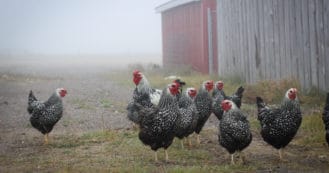
So several weeks ago when I noticed one of my Barred Rocks with a little wound on her foot, I didn’t think much of it. She was a little tender acting, but I’ve had chickens with similiar spots before, and the problem usually resolves itself.

And then we got hit with the stomach flu… Hubby did all the chores for about four days, since I was pretty much non-functioning…. In the fray, I completely failed to mention the wounded chicken to him.

When I started feeling better and made it back outside, I went to check on the coop. The injured hen was sitting in a nesting box and seemed ok– until I saw her foot. It was ugly… The wound had definitely worsened.

chicken injuries

Of course, I felt terrible– and I knew that I needed to address the wound. And of course, I turned to my stash of essential oils.

I heavily diluted several oils and headed out to the barn. I applied the oils to the chicken’s foot twice that day, and saw a noticeable improvement the next morning.

The wound wasn’t red and oozy anymore, and it was starting to scab over.… [Continue Reading]

7 Things You Shouldn’t Feed Your Chickens

what not to feed chickens

Okay, okay… So the title is a little dramatic.

It’s really not a sin to feed your chickens these things, and not all of them are deadly (although they could be…), but I couldn’t resist the title. ;)

But, I figured I needed to do some research into what is healthy and not-so-healthy when it comes to feeding chickens, since I LOVE to give my girls table scraps.

In fact, it feels absolutely bizarre to me when I’m at someone’s house and I watch them throw celery tops, broccoli stems, or banana peels in the trash. That’s valuable stuff at my house!

Our goats are rather picky, and they only like choice items such as watermelon rind or cornstalks. But our chickens can be depended upon to be the homestead garbage disposals.

garden veggies

I keep a bucket right on my kitchen counter and continually toss scraps in it while I’m cooking. Things like leftover rice, tomato ends, carrot peelings, or leftover popcorn end up there, along with the occasion eggshell. (I usually save back my eggshells in a separate container to feed to my hens, but sometimes I get lazy…)

My girls eat most of what I give them, but I have noticed that they will leave items like citrus rind or avocado peels in the bottom of their scrap pan.

It got me to thinking, so I asked the folks on The Prairie Homestead Facebook page if their girls usually eat citrus. I got a bunch of differing responses, but the consensus seems to be that most chickens don’t like citrus peelings, and some folks even report that feeding citrus can result in soft shells.

So, I decided to do some research on what else I shouldn’t be feeding my flock. I’ve found that there are some definite no-nos…  I’ve been guilty of tossing most of these items into the feed bucket at some point, and I didn’t have any birds drop dead–but I’m going to be a bit more careful in the future!… [Continue Reading]