I think the irregularities of homegrown food add to its beauty..
Wouldn’t you agree? From the irregular-sized eggs to the twisted carrots in the garden, homegrown food has a rustic charm that screams, “I’m the real deal!”
However, there are a lot of folks who very accustomed to the uniform, “everything must look exactly the same” food from the grocery store. And to those folks, some of the rustic charm of the homestead food we love so much can be annoying… Or downright alarming.
Take eggs for example.
We talk a lot about eggs here on The Prairie Homestead. From the bazillions of different ways to use eggshells, to how to freeze eggs, and to how to dehydrate eggs (or not…)
Store-bought eggs are all exactly the same size… The shells are all exactly the same shade of white, and the yolks are exactly the same (pale) shade of yellow.
Contrast that with a carton of farm-fresh eggs from your flock of chickens:
- Sometimes you’ll get a double-yolker…
- Sometimes the shells range from light brown, to dark brown, to the prettiest shade of aqua…
- Sometimes you’ll find a speck or two of sawdust on the shells… (Here are my thoughts on washing eggs…)
- Sometimes a single carton will contain a tiny little egg and a massive egg right next to each other…
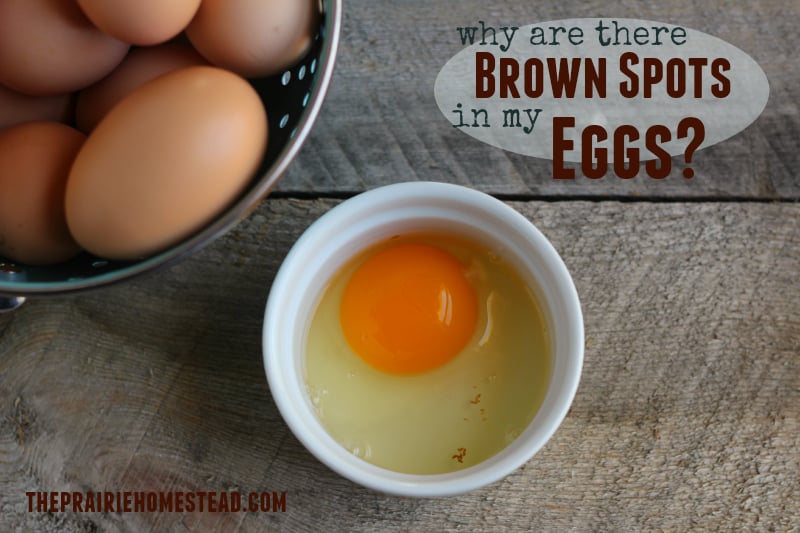
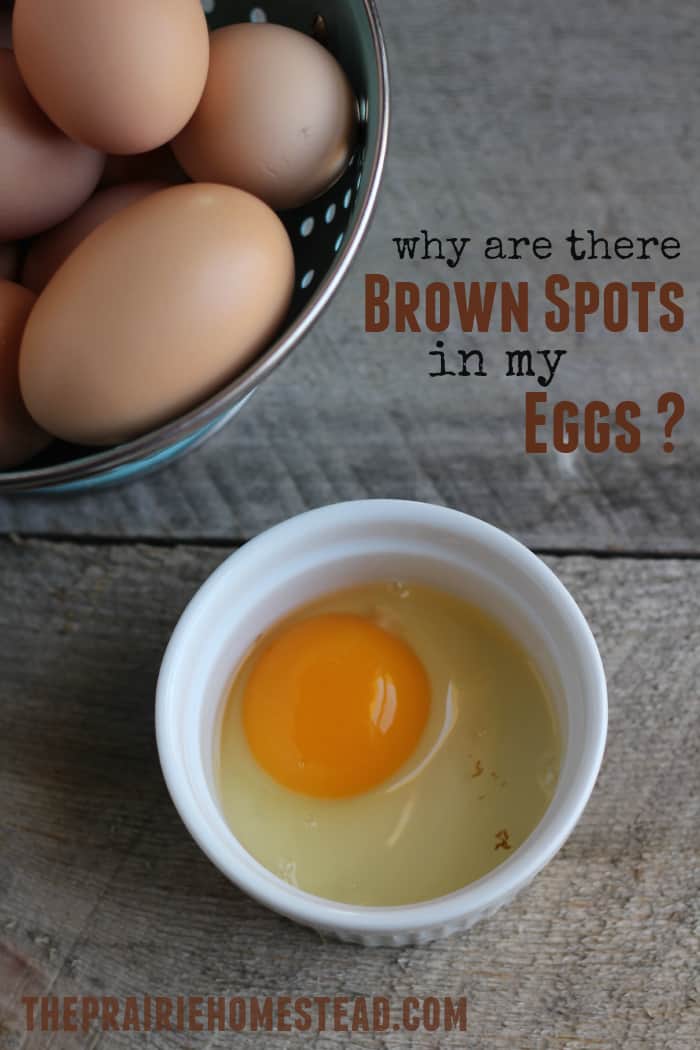
- And sometimes, you’ll find a little brown spot floating on the yolk when you crack the shell…
Which brings us to the question–
What exactly ARE those little brown spots you sometimes find in eggs?
Those brownish or reddish specks you’ll occasionally find floating in your farm-fresh eggs are deemed “meat spots” or “blood spots.”
Thankfully, they are not a cause for concern.
You see, eggs destined for the grocery store shelf are “candled” by a machine to check the inside for any defects– this is why you’ll rarely come across a meat spot in a store-bought egg.
Backyard chicken owners can candle their eggs as well, but it’s not a necessity. (How to candle an egg at home)
Contrary to popular belief, a meat spot in an egg does not mean that it has been fertilized.
It’s actually a little malfunction on the part of the hen. According to the Egg Safety Center:
[Meat spots or blood spots] are caused by the rupture of a blood vessel on the yolk surface when it’s being formed or by a similar accident in the wall of the oviduct… Eggs with blood spots and meat spots are fit to eat.
I’m glad they have been deemed “fit to eat,” because although I will sometimes dig out the larger spots, I usually just ignore the smaller ones and scramble them up. *a-hem*
And here is another interesting little tidbit– the presence of visible blood spots can actually mean the egg is fresh. According to the Eggland’s Best website:
As an egg ages, the yolk takes up water from the albumen to dilute the blood spot so, in actuality, a blood spot indicates that the egg is fresh.
Perhaps another reason you don’t often see blood spots in store-bought cartons is because those eggs are usually several weeks old by the time they make it home to your refrigerator.
I can’t seem to find a concrete reason as to why some chickens lay eggs with meat spots and others don’t… Some sources say that older hens are more inclined to brown spots, while others say it’s reserved for younger birds. And some websites refer to it as a genetic defect or a dietary problem. Perhaps this is an issue I will have to dig into deeper in the future…
So next time you crack an egg from your backyard flock and find a little speck floating in the bowl, don’t be alarmed. If you like, you can remove it, or just ignore it.
Enjoy the little irregularities in your homegrown food and allow it to remind you of the valuable work you put into getting it on your table.
Some other egg-y posts you might like:
- Should I wash my eggs?
- How to Cook Non-Stick Eggs in a Cast Iron Pan
- How to Freeze Eggs
- How to Naturally Disinfect the Chicken Coop
- How to Dehydrate Eggs (or not…)
- How to Feed Eggshells to Chickens
- 30+ Things to do with Eggshells




Meat spots and all I’d never go back to store eggs. If my hens aren’t laying we do without eggs. Thanks for the very informative article!
I agree Missy! Ours recently slowed down their laying for a while, and I refused to buy the store ones… We just didn’t have scrambled eggs for a while. 😉
Actually, the fertile eggs have a much lower cholesterol count than the non fertile ones.
thanks jill but when i dont have eggs i just settle for nut
Thanks for the information on this subject. We were wondering about this here on our homestead. Now we know!
Thanks, Jill. I’ve wondered about that!
Eggellent article!! I have always wondered about that. In fact I know some people who don’t eat eggs because they think that egg was supposed to be a chicken. Now I can share this news with them. Thanks.
I wondered about these spots. We get them from time to time and they are definitely in my one older hen’s eggs all the time. Usually I fish the bigger ones out because I’m squeamish, but I know they don’t hurt anything.
Thank you for this article. I have had older chickens, younger chickens, and everything in between that had blood- and meat-spots in their eggs. The most common answer I’ve had for it was I wasn’t feeding my chickens the right vitamins and minerals. I’ve had people who got eggs from me accuse me of giving them rotten eggs because there was blood in them. I’m so glad to know my chickens aren’t the only ones with this “problem”!
Nope, you are definitely NOT alone! 🙂
Good to know! I knew they couldn’t possibly be a “fertilized” egg because we have no rooster. 😉
I have had blood spots before but not in a long time. Our new hens usually don’t have them. We do not have a rooster so they can’t be fertilized.
You can eat a fertilized egg
Somewhere along the way I read that meat spots are genetic and can be passed down (I think in one of my chicken handbooks). Hardcore heritage breeders will actually cull hens who lay with meat spots, which I thought interesting. They certainly do no harm, though I usually fish the big ones out, too. 😉
I am AMAZED at how many people think eggs are aborted (fertilized) chickens, or that chickens won’t lay without a rooster, etc… My Mom wouldn’t feed her hens leftover egg scraps because she thought it was cannibal. I tried not to laugh at her too hard… 😉
I buy eggs at our local Natural Grocers store (I’ve done a lot of looking around and these are the best I can get for now.) They sometimes have these spots in them and I was curious why I never saw them in cheap grocery store/WM eggs that we used to eat. Sometimes we buy Organic Valley eggs (with the red label) and they sometimes have spots too. I sometimes scramble the eggs just to hide it, but figured it was not a big deal, but odd things can seem gross! (sorry for the overuse of “sometimes” lol.) We’re in a rental house and cannot have chickens right now. I can’t wait to raise our own hens someday! We had them when I was a kid, along with a couple ducks.
Thanks for posting this! I had to do a lot of research on this a few weeks ago when some of our eggs were turning up with meat spots. I couldn’t find any information online that was as concise as yours, I had to go to a ton of different places to get the same information you provided here. P.S. I love you blog! Just found you a few weeks ago! 🙂
My grandmother, who grew up on a farm, said they were fine and to eat the food I was given. I’ve never thought about it since I asked when I was a kid. I just keep on going. Rotten eggs are so easy to spot/smell that I egg freshness is last on my list of life worries. I get them from one or two farmers and know they’re fresh that week, and go with it. I learned as a child not to be squeamish about too many things. So glad my gram lived on a farm, and lived with us when I was a kid, because I grew up in NYC where a lot of my friends were freaked out by any food non conformity.
This is very interesting! Glad I now know what those reddish spots are. I don’t have a problem eating them, but I’ve always wondered what they were. Thanks for sharing!!
Thank you for writing this article. You don’t know how much this helps ease my mind! I won’t lie. I have an anxiety disorder and have several food phobias (for instance, i am terrified of “sea things”. Like fish. Squid. Lobster. You name it and chances are if it lives in water, I’m scared of it. Weird, huh?) Anyways, whenever I saw those spots, I’d add them into my dog’s dry dog food for a treat. I thought it meant the egg was fertilized. And the thought of that grossed me out.
I think what grosses me out a million times more is when people intentionally eat fertilized eggs. I live in an area with a large asian population. I used to go to one filipino store for these cheap awesome sandwiches they had. Then, one day, I saw an open carton of eggs on the counter. On closer inspection, I saw they were cracked open, complete with dead baby chicks inside. UGH! I never could go back to that store again.
Turns out, in some areas of the world, fertilized duck eggs are kept and incubated until the baby ducks reach a certain age. Then, when they reach a certain point, they boil the eggs andbury them in sand. Then, at some point, they unearth the eggs, dig them up, shell them and eat them whole. They consider it a snack.
I can handle all the double yolked eggs ever (i once had a whole carton of double yolked eggs!) But the whole “eating boiled dead baby duck chicks” is too much for me. :s
Ive tried to eat one of those you speak of. In the philippines, they’re called *balut*. I tried it once and spat it right out. It was way too salty for my tastes. Tasted like I was eating a whole canister of salt. lol
I’ve often wondered about the spots, we gave eggs to a friend once, and were told that some of those eggs had “dukie” I believe they meant poop. Needless to say they never got eggs from us again. I won’t be worrying about this again. Thanks so much.
I COULDN’T EAT ONE OF THEM EITHER!
A local man had a layer house and sold eggs locally in a large chain store. He also had a little 10’x15′ shack in a parking lot where a woman sat and sold cartons and flats of eggs. I kept getting eggs with bloody spots, large ones. Finally, I called and talked to the guy personally. I knew him and never wanted to complain. He was really angry about the blood. He said predators came around the chicken house and the keepers were not supposed to shoot off a gun the scare the predators. He explained that loud disruptions would cause the hen’s body to somehow cause the blood spots. From that day on, there were never blood spots. I don’t know whether it is true or not, but until today, I never thought about whether it was true or not.
When I was a kid I used to go with my friend to collect eggs from his aunts hen house (60’s) .I noticed a red spot on the outside of an egg. It was explained to me that the hens were not used to me so it caused their blood pressure of the hens to go up ,consequently causing these red spots to appear. I assume that loud noises would also cause high blood pressure.
My dad was a pioneer , we sold eggs for groceries so we hand candled them . Dad said the same type of thing.. dogs to near or chasing chickens, predators near , loud noises, chickens to active is what he claimed as the cause.
Thanks for all the valuable details about the eggs, and I love your blog.
I have one hen that has meat spots on her eggs every once in while. She is only about a year old. Even with having to pick it out if I am frying the egg instead of scrambling, the eggs are still far superior to store eggs.
Thanks for this information. I love the fresh organic eggs I get at the local farmers market. Recently I’ve had quite a few eggs with blood spots in them. When I inquired about them, I was told that they are caused by stress in the chickens. Interesting that one week virtually all of the eggs in a carton have them, and the next week there are none. From that point of view it seems like a reasonable explanation.
Hmmm… that would definitely make sense!
I bought a carton of free range eggs for the first time to support the better treatment of the animals, I opened eight. On cooking shows they say to always break an egg into a small clear glass dish to examine the egg to make sure there are no blood spots, well 6 out of 8 had red or brown spots so I dumped every one down the drain. I was not happy at all and thought about returning the eggs for my money back. I’m so happy I read this because I absolutely loved the color of the yolk, and now I ll simply do the fresh test and eat the remaining 4, they cost more than twice as much as the regular eggs in my area so I’m glad all my money hasn’t gone to waste. And I can still support the proper treatment of animals
We get farm-fresh eggs delivered weekly with our CSA box, and I’d always wondered what those spots were. Not that it stopped me from using the eggs — I have no doubt they’re safer and more nutritious than anything laid by hens imprisoned in the big factory poultry barns. But it’s good to know this info. Thank you!
I’d love if you’d come join my How To Tuesday link party, too.
http://housewifehowtos.com/link-party-2/how-to-tuesday-link-party-9/
Great post! I’ve noticed that more of ours have blood spots in them since it’s been so cold out as well. I just figured it was stress of the cold and possibly lacking in certain minerals or vitamins due to weather (and the fact that they were all terrified of the snow for awhile there and refused to leave the coop – LOL – good thing we built it big!). I also scoop out the really big ones, but the flakes I leave alone. Ours have sawdust and hay on them too 🙂 Let’s face it, there is hay on me more often than not, it’s going to get on/in everything!
Does it ever and messy “stuff” on my boots.
I stopped throwing mine out after I understood that fertilized eggs aren’t sold for egg use. They are used to make more chicks. I’ve never gotten sick from one; and nor has anyone else whose eaten whatever I’ve cooked/baked with them.
Thank you for posting what I learned on my own over the years! Blessings!!
Cheers to farm fresh eggs!!!
I’ve often wondered about this, since I’ve even blood spots in store-bought eggs, and as such figured that it can’t be due to fertilization. Thanks for clearing this up for us!
You betcha Mali!
I’ve heard that it is a mineral deficiency.. and diatomaceous earth prevents it.
Hmmm.. interesting– I’ll have to look into that!
I have found little specks of something black it looks like dirt .
Thanks, our family has always wondered wha they were but have eaten them anyway….figure they have to be natural if they are inside the shell 🙂 We have 12 hens and our oldest bantam will be 10 in October – she’s a little beauty, her name is Cloudy and she has hatched most of our other hens. People ask why we keep them once they stop laying but they are our pets – same as our dogs, fish and cockatoo 🙂 Thanks again – love your site!
Wow– 10! Yes, they do become a part of the family, huh? 🙂
Aw, this is great!
I’m wondering how you know they would not have developed into an embryo since chickens are one of those species that don’t necessarily need a male to reproduce: http://www.thepoultrysite.com/articles/837/parthenogenesis-embryonic-development-in-unfertilized-eggs-may-impact-normal-fertilization-and-embryonic-mortality I’ve always assumed these eggs would have developed into chicks, and it seems that people who have a rooster have a much higher number of these eggs. So I’m wondering if you just assumed they were not embryos because there was no rooster present, or if this is actual finding that is documented somewhere?
A fertilized egg has a tiny “white” spot. I say white because, against the dark yellow yolk, it is a faintly lighter color, but the spot is also somewhat translucent. It’s difficult to describe but easy to see once it’s pointed out. I have never been able to see it when candling eggs, but I can spot it (no pun intended) right away once the egg is cracked.
Thank you for this because I just started buying pasture raised eggs and I was definitely looking at my egg yoke like no no no no. Lol I will proceed to eat my eggs with cheese now.
We purchased laying hens from a local large farm who said they were in the process of reducing their flock. We had just become interested in raising our own layers but waited too long to get chicks. Every single one of those hens lay eggs with the hugest blood spots. After reading up on it, we figured out that the farm was probably culling the hens that had a genetic propensity to them. We have since purchased chicks and none of them lay eggs with blood spots.
Very interesting– sounds like it definitely could be a genetic deal.
On occasion I will get get an egg with a meat or blood spot in them but it’s not an every egg occurrence. Regardless, I would never go back to store bought eggs. Here a few weeks ago we had sold all that we had and didn’t even have enough for us to have breakfast. We eat eggs every single day!! 🙂 Thank you for the awesome website!!
You are welcome Tammy- thanks for taking the time to comment. 🙂
I buy my organic free range eggs at the grocery store all the time and they always have these spots. I am inclined to think they may be stress related….but I am not expert.
Everyone is using the word “grocery egg” but I think the proper way to differentiate would be…. “Conventional” – as I state above, I buy my lovely delicious organic uneven sized eggs from the large grocery store chain near us since small farms are not nearby. My BIG question that I have been dying to ask someone is Why are all organic eggs brown?????
Well, you can definitely still have organic white eggs, but it seems that a lot of farmers/homesteaders prefer the “brown egg layer” breeds. 🙂
yes, I have eaten organic eggs for at least ten years now, and I have never seen a white one, that I remember!
The color of the eggs is totally due to the breed of chicken. I always laugh when people see some of my eggs are green and think they are rotten. The green ones are from Aracauna or Americauna hens. Most heritage breed hens lay brown. There’s nothing wrong with white eggs if the hens are on pasture. People just see white and think they are the tasteless eggs that most stores carry. I’ve got a couple of Leghorns and their white eggs are just fine.
We have a Barred Rock that has meat spots in her eggs, then we have a Buff Orpington that lays eggs so big we cannot close the egg carton. We love our chickens and I don’t eat store bought eggs anymore, they just don’t taste like eggs.
I wish we could raise chickens or had access to farm fresh. I buy the closest I can get, ‘free range, pastured’ all the buzz words. Enjoyed this post and the one about not washing eggs. Made me wonder about boiling eggs – I always start them in cool water – does that cause bacteria to pass through the membrane? Since you have a wealth of knowledge about eggs, I wonder if you might could answer a second related question? How long is it safe to store hard boiled eggs in the fridge? I haven’t had any luck in finding an answer. Thanks!
Hmmm…. good question! I know I’ve stored some for weeks without them going bad. (I’m probably going to get the Food Police knocking on my door after typing that, ha!) I would say that as long as the hardboiled egg still looks/smells ok, it’s probably just fine to eat.
I have seen many of these over the years in conventional, grocery store eggs. If they are small enough, I ignore them.
Hi, I was a little squeamish about yolk blood spots at first…but then I thought, “Hey, I eat meat that, when it is raw, has blood in it “, After cooking, the blood goes away…same with cooked eggs. I’ll scoop out the blood spots on eggs for my husband because he’s more fussy and gets creeped out easier! 🙂 Love my hens and fresh eggs!
I sometimes find a bloody liquid throughout the egg white from my free range fresh eggs… It is gross to break open an egg and blood runs out. This does not look appetizing.. What causes this??? I have also found this in just regular store bought eggs…
Hmmm… Whenever I’ve had that, it because the egg was fertilized.
Yesterday’s breakfast eggs ended in the garbage as one of the egg’s creeped me out! There were a dozen or more small (1/16″ +/-) perfectly round light beige things attached to the yolk and also some larger clumps that looked like pockets of undigested food, or…? I poked at it a bit and it was not readily removable. I didn’t even want to feed this egg to the dog. Ever come across something like this? My chickens are healthy, if a bit on the “older” side, meaning 2-3 years old.
I just got my first egg from a RIR. On the white was a black “stringy thread” like thing about 1″ long – nothing like a blood spot or meat spot that I’ve seen described in so many posts. As I started to remove it, it just broke apart into smaller pieces. I removed it all and used the egg, but I’m wondering what it might have been. Thanks for any information.
A while back I cracked a fresh egg that had a tiny gray disk-like object in the yolk., the size and shape of a flattened lentil bean. It grossed me out and I tossed it, later kicking myself that I didn’t take a picture first. Any thoughts on what that may have been. I assumed it was maybe a parasite, but I’ve never seen anything like it since.
Hmmm… I have to say that I’ve never personally seen anything like that before–sorry to not have any ideas for you!
I’ve always considered the “blood spots” to be X-tra protein. 🙂
.
You bet! 😉
When we first started looking into getting chickens, there were no chicks available. We purchased grown laying hens from a local farmer who advertised that he had too many and was culling his flock. Every single egg laid by those hens contained prolific blood spots and streaks. As new hen owners, we were pretty grossed out and didn’t eat our own eggs for a long time. We later discovered that the farmer was culling his flock of the hens with a genetic propensity to blood spots. A few years later we have 17 hens we’ve raised from chicks and I only see blood spots in one out of every 100 or so eggs. From our experience, I’m convinced that it can be a genetic issue in some hens and an occasional anomaly in others.
Thanks for the explanation. In an effort to buy eggs from suppliers that don’t cull their male chicks, I’ve been buying mine at a local co-op. I’d been told that a red spot meant the egg was fertile. Glad to know that’s not the case. And glad to know it probably means the eggs I’m buying are just really fresh.
Thanks for such a great article and so glad I found it today! I have adopted a cleaner eating lifestyle and have been amazed at the number of winter markets we have so close. I found a chicken farmer, beef farmer, dairy farmer, many vegetable farmers, etc. I just today made my first omelette with fresh eggs and there were a couple of spots in them. I assumed they were ok and kept cooking 🙂 I’ll never buy grocery eggs again! I’m slowly cleaning out my freezer and almost all local foods and all I can say, I haven’t felt better in my life. Thanks for such a great article and I’ll be linking to it this week!
Thanks sooooo much for this information…you have a new fan!
I know about meat/blood spots in the yolk when you break open a farm fresh egg (and if I had a place where I could get a steady supply you’d never catch me near a store-bought egg EVER – wish I could convince hubby to have a few layers) but today I boiled some eggs for chicken salad and there were spots in the WHITES not the yolk. I tasted the white (figured if it was bad I wasn’t eating enough to get sick…I hoped LOL) and it tasted fine but I hung on to it to show hubby who grew up around chickens, beef, pigs, and all that stuff and even he didn’t know. Do you know what those are??
Thanks 🙂 I liked this website – good info here.
Hey everyone I have read all your comments and I would like to comment on some questions …we have a flock of 300 hens and sell to all different venues…my experience with blood spots is that it is stress related and not genetic..also I hear a lot about people not eating eggs that have been fertilized..Just so you all know the fertilization process takes place after the egg has been warmed to 99 degrees in an incubater and then the embryo starts to grow and forms the baby chick…so unless you are eating eggs that are kept in a very warm place you will not eat a “baby chick”.there was also someone that commented that hens can reproduce with out a rooster..this is incorrect..you need a male and female chicken to have babies..we run a few roosters with our flock ..they protect the flock and alert them to any danger and calm them as well. .we sent out 100 + dozen eggs a week all fresh that week and everyone is very happy with them.
Well said Michelle. We also have roosters and agree with all that you explained. I raise chickens for eggs and there is nothing wrong with eating a fertilized egg. It does not mean a chick is starting to form. Like you said, you need the temperature and humidity to be right for it to start to form. I have had some customers question my “coloured” eggs from my Aracauna and Americauna hens. I have had them question if the eggs are any good. I did want to ask one question to others that have those breeds. Have you noticed the Americauna and Aracauna eggs seem to be easier to peel when you hard boil them?, compared to other breeds. Same age of egg that I have used.
I have a question actually. I bought some farm fresh eggs from my neighbor and this time there seemed to be “water inside the shell ” when I cracked one.. What does this mean..
I always wondered about those little spots. Thanks for sharing! I just love coming over here for a visit and living vicariously through you and your wonderful homestead!! xo
Use a spoon along the inside of the shell. It’s the easiest and fastest way to peel an egg. Comes o
out beautiful.
Our one year old plus, Bantam Ru is raising havoc with one of my hens. She has been a good producer averaging one well developed extra lg. egg a day. But for the last two weeks plus Ru-Ru has been attacking my hen “Cinnamon”. My first observation of this left me with thoughts of a barn yard disagreement.
But after 3-4 days of observing his bizarre and frequent attacks. I thought it was his desire to mate or possibly he was expressing or establishing a pecking order. But when Cinnamon would assume a submissive posture rather then mount her as I expected him to do he runs around in front and pecks her head to the point of removing feathers.
In spite of the facts that he crows frequently and in appearance is definitely “The cock of the walk”, he has chosen to make life miserable for Ms. Cinnamon and has become a barnyard bully.
In an effort to allow her some relief from his aggressive and abusive attacks I have isolated the little creature to the chicken tractor where for the time being he can assault his shadow till his hearts content and I can learn what is causing this aggression and put a stop to it.
The little rascal lives a charmed life, as the stew pot for him, is out of the question. As he is my wife’s pride and joy having raised him from an escaped and captured Easter chicken two Easter’s past.
Any ideas, comments or suggestions would be gratefully received.
OD. (The bad old jailer).
I have found three eggs like this in the last carton I bought. I wanted to make sure they were not parasites or something lol.
i’M new whit Prairie Homestead but I do have a question, some of my chickens have blood spots on the egg shell itself is there something that is causing it?
Thanks
Gloria from Oregon
Do?s y?ur blog have a contact page? I’m having trouble
locating it but, I’d like to send you an e-mail. I’ve got some
creative ideas for your blog you mig?t be interested in hearing.
Either way, gre?t site and ? look forward to seeing it improve
over time.
Thanks for the information regarding the “meat spots”. I thought it was from the feeds , glad to know they are safe to eat. We had been sharing our eggs to our friends and I was concerned that they may think the eggs are contaminated. We are enjoying our three hens and glad to share what they provide us every day.
I would also like to ask how long can you keep the eggs that the hens lay everyday in room temperature? I have a friend who told me that it is safe to keep the homegrown brown eggs unrefrigerated because they have not been processed and they have a protective lining within the shell
I’d like to help confirm that’s it’s always been my older hen laying either the bigger eggs or the spotty ones, simply because the spotty ones are the biggest, and she’s the alpha. I like them all the more after reading this 🙂 thanks!
I have new hens. One just started laying and she lays each egg with a spot from red to brown. The eggs taste so fresh, I just figured if they stayed around a few weeks the spots would probably desinigrate and you’d never know they were there. If I see a spot, I just use the shell to fetch it out and cook the egg up! I never ever want to go back to store bought eggs. I know the good organic food I feed mine and that’s the kind of eggs I want to eat!
I really enjoyed this article, and it came in good time. A couple days after reading it I bought some farm fresh eggs at an Italian market. Some were very strange, with unsmooth sides and spots and the like, my coworkers with me were repulsed but thanks to your article I just saw them as a great deal.
Cracked two open just now and smiled at the different sized yolks, thanks to you 🙂